Causal Discovery
The Causal Discovery tool generates a directed acyclic graph (DAG) that represents the causal relationships between variables in your input dataset(s). This generated DAG can then serve as the foundational causal specification for your causal model.
Note
Automated causal discovery is a starting point. The resulting DAG must always be manually inspected to ensure it is a valid representation of your system.
Configuration Options
The tool supports various configurations to tailor the discovery process to your specific dataset and domain knowledge:
Technique: Choose the causal discovery algorithm to use. Currently supported techniques are HillClimb and NSGA. You can add custom techniques by implementing abstract_discovery.py and adding the new technique to your endpoints in pyproject.toml.
For additional control on the search process, you can specify the following optional parameters:
For both techniques, you can specify the
max_iterationsandrandom_seedparameters. As well as domain knowledge constraints (see below).For the HillClimbing technique, you can specify the
max_iterations_without_improvementparameter. Where max_iterations_without_improvement is the number of iterations after an improvement is found, before the algorithm widens its search space to avoid getting stuck in a local minima.If you are using the NSGA technique, you can specify the
population_sizeandnum_parents_matingparameters.
- Parameter defaults:
max_iterations: 100max_iterations_without_improvement: 10population_size: 5num_parents_mating: 2random_seed: 0
Domain Knowledge (Edge Constraints) You can explicitly include or exclude specific edges in the output DAG using dot files. Regular expressions (regex) are supported.
Example: Consider the DAG for the vaccinating the elderly modelling scenario. This scenario has two inputs:
vaccineandmax_doses.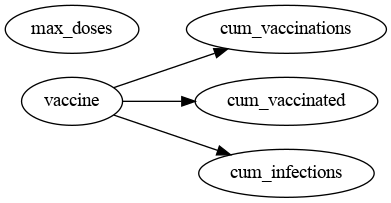
Excluding Edges: If domain knowledge dictates that
max_doseshas no causal effect on any outputs, you can specifymax_doses -> ".*"and".*" -> max_dosesin the exclude edges dot file.Including Edges: If it is known that
vaccinedirectly affects all three outputs, you can specifyvaccine -> "cum_.*"in the include edges dot file.Specifying Variables: You can specify the variables to include in the discovery process using the
--variablesargument. If not specified, all variables in the input dataset(s) will be considered.
Examples: To generate a DAG using the HillClimb technique with a maximum of 500 iterations, with 25 iterations without improvement, a random seed of 63, you can use the following command:
causal-testing discover \
    --technique HillClimberDiscovery \
    --data-paths /test_data1.csv /test_data2.csv \
    --output /tmp/resultant_dag.dot \
    --technique-kwargs max_iterations=500 max_iterations_without_improvement=25 \
    random_seed=63
Or to generate a DAG using the NSGA technique with a population size of 10, a num_parents_mating of 3, and specified included and excluded edges, you can use the following command:
causal-testing discover \
    --technique NSGADiscovery \
    --data-paths /test_data1.csv \
    --output /tmp/resultant_dag.dot \
    --include-edges /include_edges.dot \
    --exclude-edges /exclude_edges.dot \
    --technique-kwargs population_size=10 num_parents_mating=3